
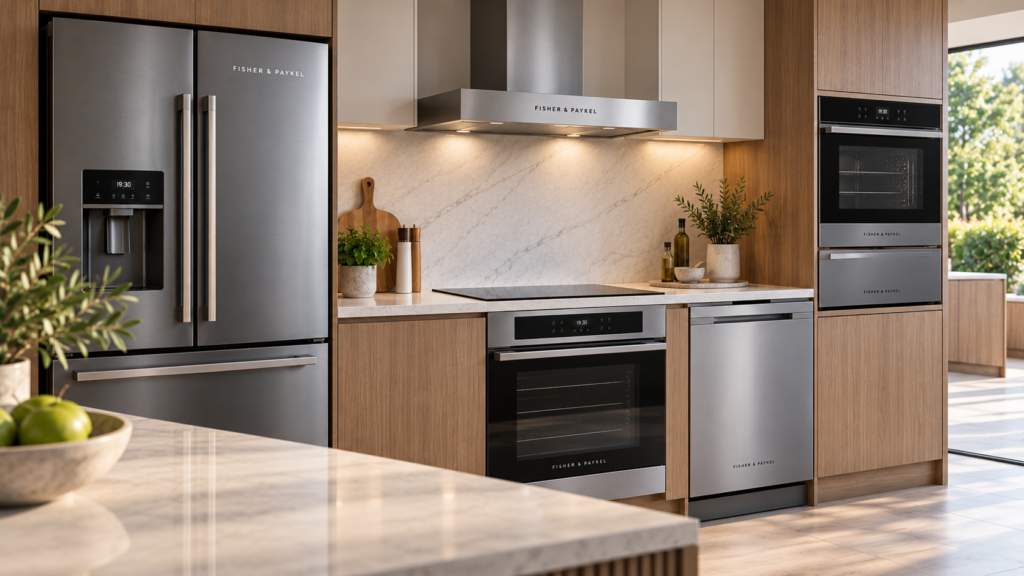
Artificial intelligence is no longer something that only exists on computers and smartphones. AI-powered home appliances are increasingly appearing in Australian kitchens and laundries, promising to make everyday household tasks easier, more efficient and more personalised.
Modern washing machines can adjust cycles according to the load, refrigerators can monitor temperature and usage patterns, and some ovens can assist with choosing cooking settings. Even dishwashers are becoming smarter, using sensors to adjust how a cycle operates.
But are these increasingly intelligent appliances actually making life easier? And perhaps more importantly, what happens when all that technology stops working?
Here are seven ways AI and smart technology are changing the appliances we use every day.
1. Washing Machines Are Learning More About Your Laundry
Modern washing machines have come a long way from simply selecting a water level and choosing between hot and cold.
Depending on the model, newer machines may use sensors and intelligent technology to detect factors such as load size, fabric characteristics or how much water is required.
The appliance can then adjust aspects of the wash cycle automatically.
For households, this can mean less guesswork when choosing settings and potentially more efficient use of water, energy and detergent.
However, beneath all that intelligence, a washing machine still relies on familiar components including pumps, motors, valves, hoses, bearings and electronic control systems.
When something goes wrong, proper diagnosis remains important.
2. Refrigerators Are Becoming Smarter Too
The humble refrigerator has also undergone a technological transformation.
Modern refrigerators can incorporate sophisticated temperature sensors and electronic controls designed to maintain appropriate conditions inside different compartments.
Some premium smart refrigerators take things much further, offering connected features, touchscreens, notifications and other functions designed to help households manage food and everyday routines.
However, the fundamental job hasn’t changed.
Your refrigerator still needs to keep food consistently cold.
If temperatures begin fluctuating, food isn’t staying cold or unusual noises appear, the fact that a refrigerator is “smart” doesn’t necessarily mean it can solve the underlying problem itself.
3. Dishwashers Can Adjust How They Clean
Modern dishwashers increasingly use sensors to determine what’s happening during a wash cycle.
Rather than every load being treated exactly the same way, sensors can help the appliance adjust aspects of its operation depending on the conditions detected.
This can potentially improve efficiency while reducing unnecessary water or energy use.
But smart technology doesn’t eliminate traditional dishwasher problems.
Blocked filters, drainage problems, faulty pumps, water supply issues, worn components and electronic faults can still occur.
In other words, the dishwasher may be getting smarter, but it hasn’t become immune to breakdowns.
4. Ovens Are Taking Some of the Guesswork Out of Cooking
Ovens are another area where manufacturers are introducing increasingly sophisticated controls.
Depending on the appliance, features may include guided cooking programs, temperature monitoring, connected controls and automated cooking settings.
Some smart ovens can help users select suitable settings for particular foods or provide notifications through connected devices.
That’s convenient when everything is operating correctly.
But heating elements, thermostats, fans, door components, sensors and electronic controls still have important jobs to do.
Technology may change how we interact with an oven, but the appliance still relies on physical components to produce and regulate heat.
5. AI Could Help Appliances Use Resources More Efficiently
One of the more practical benefits of AI-powered home appliances is their potential to make decisions based on what is actually required rather than always operating in exactly the same way.
For example, an appliance may be able to alter a cycle based on the size of a load or information received from internal sensors.
Over time, increasingly intelligent controls may help households use water and electricity more efficiently.
However, it’s worth remembering that features differ significantly between manufacturers and models.
Not every appliance marketed as “smart” uses artificial intelligence in the same way, and some connected features are primarily about convenience rather than improving the appliance’s core performance.
6. An Error Code Doesn’t Always Tell You Exactly What’s Wrong
This is an important one.
As appliances become more sophisticated, they can often detect abnormal operation and display an error or fault code.
That’s useful information, but an error code shouldn’t always be interpreted as a definitive diagnosis.
The code may indicate the system or area where a problem has been detected rather than identifying the exact component responsible.
For example, what appears to be a drainage error could have several possible causes.
Replacing a component purely because an error code appeared can therefore result in unnecessary expense if the underlying fault hasn’t been correctly identified.
Professional fault diagnosis remains valuable even when the appliance itself is providing information about the problem.
7. Smarter Appliances Can Mean More Complex Repairs
Today’s appliance repair technician may need to understand much more than mechanical components.
Modern appliances can combine motors, pumps and heating elements with electronic control boards, sensors, wiring and increasingly sophisticated software-controlled systems.
That can make diagnosis more complex.
A problem that appears mechanical may actually involve a sensor or electronic component. Likewise, what appears to be an electronic fault may ultimately be caused by another part of the appliance.
As household technology evolves, correctly identifying the cause of a fault becomes increasingly important.
Does More Technology Mean Appliances Won’t Break Down?
Unfortunately, no.
Smart technology can help an appliance monitor its operation, adjust settings and alert you when it detects a problem. It can’t eliminate normal wear and tear.
Door seals can deteriorate. Pumps can fail. Heating elements can stop working. Bearings can wear. Hoses can develop problems and electronic components can develop faults.
In fact, adding more sensors and electronic systems can introduce additional components that may eventually require diagnosis or repair.
Should You Repair or Replace a Smart Appliance?
A fault doesn’t automatically mean a modern appliance needs to be replaced.
The decision will depend on factors such as the appliance’s age, overall condition, the nature and cost of the repair, availability of parts and the cost of an equivalent replacement.
Having the fault properly diagnosed gives you much better information when making that decision.
It may turn out to be a relatively straightforward repair rather than the major failure you expected.
The Future of Appliance Repairs
Household appliances will almost certainly continue becoming more connected and intelligent.
AI, sensors and automated controls may change the way we wash clothes, store food, clean dishes and prepare meals, but the basic principle remains the same: appliances contain components that need to work together correctly.
When one of those components fails, identifying the actual cause of the problem is the first step towards fixing it.
Blackburn Appliance Repairs provides professional appliance repair services for households across Brisbane’s eastern suburbs specialising in Fisher & Paykel repairs.
So while AI-powered home appliances may be getting smarter, there will still be times when they need something technology hasn’t replaced – an experienced appliance repair technician who can work out what’s actually gone wrong.